Gin Rummy is a classic two-player card game that combines skill, strategy, and a touch of luck. The objective is to form your cards into valid combinations called melds while minimizing your deadwood (unmatched cards). Our implementation supports 2-4 players and includes several house rules that add depth and excitement to the traditional game.
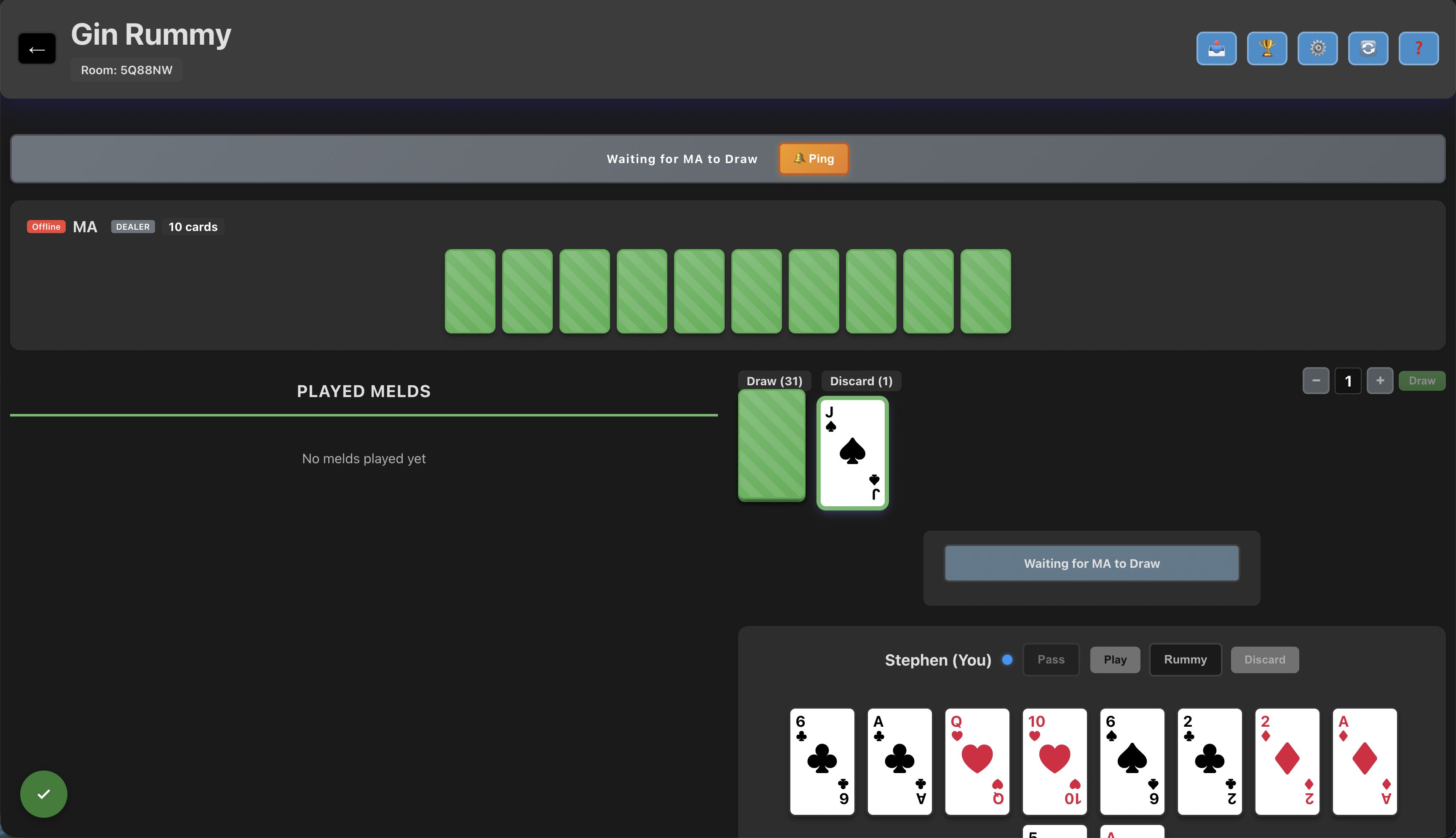
Quick Start: Each player receives 10 cards (or 7 cards with 3-4 players). Take turns drawing a card and discarding one. Form melds (sets of 3-4 matching ranks or runs of 3+ consecutive cards in the same suit) to empty your hand and win.
Game Setup
Gin Rummy uses a standard 52-card deck. The number of cards dealt depends on the player count:
| Players | Cards Dealt | Room Capacity |
|---|---|---|
| 2 players | 10 cards each | Up to 50 total (with spectators) |
| 3 players | 7 cards each | Up to 50 total (with spectators) |
| 4 players | 7 cards each | Up to 50 total (with spectators) |
After dealing, one card is placed face-up to start the discard pile, and the remaining cards form the stock pile (draw pile).
Understanding Melds
A meld is a valid combination of cards. There are two types of melds in Gin Rummy:
Sets (Groups)
Three or four cards of the same rank, regardless of suit.
- Valid set: 7 of Hearts, 7 of Diamonds, 7 of Clubs
- Valid set: King of all four suits
- Invalid: Only two cards of the same rank (need at least 3)
Runs (Sequences)
Three or more consecutive cards of the same suit.
- Valid run: 4, 5, 6 of Hearts
- Valid run: 10, Jack, Queen, King of Spades
- Invalid: 4 of Hearts, 5 of Diamonds, 6 of Hearts (must be same suit)
Wrap-Around Runs (House Rule)
Our implementation supports wrap-around runs, allowing sequences like King-Ace-2 of the same suit. This adds strategic depth as you can connect high and low cards:
- Valid wrap-around: Queen, King, Ace, 2 of Clubs
- Valid wrap-around: King, Ace, 2, 3 of Hearts
Strategy Tip: Wrap-around runs open up more meld possibilities. An Ace can connect to both Kings and 2s, making it more versatile than in traditional rules.
Turn Structure
Each turn consists of two phases: drawing and discarding.
Phase 1: Draw
You must draw exactly one card from either:
- The stock pile: Draw the top face-down card (safe but unknown)
- The discard pile: Take the top face-up card (known but reveals information to opponents)
Multi-Card Discard Pile Draws (House Rule)
Our implementation allows drawing multiple cards from the discard pile, adding a strategic layer:
- You may draw up to 5 cards from the discard pile in a single draw
- Required card rule: The bottom card (the one deepest in the pile that you're taking) must be used in a meld or laid off during that turn
- The other cards you pick up can be kept as deadwood or used in melds
Important: If you draw multiple cards from the discard pile, you must immediately use the bottom card. If you cannot legally use it, the draw is invalid.
Phase 2: Discard
After drawing, you must discard exactly one card face-up onto the discard pile. You cannot discard the same card you just drew from the discard pile on the same turn.
Undo Before Discard
Made a mistake arranging your hand? You can undo your actions and return to the post-draw state before committing to a discard. This is especially helpful when you're working out complex meld arrangements.
Rummy Claiming (House Rule)
One of our most exciting house rules is the rummy claiming system, which allows out-of-turn plays:
How It Works
- When any player discards a card, there's a brief window before the next player draws
- During this window, any other player can "claim" the discard if they can immediately use it
- To claim, you must be able to add the discarded card to an existing meld on the table or use it to complete a new meld from your hand
- If multiple players want to claim, priority goes to the player whose turn is closest
Claiming Rules
- You can only claim if you can immediately meld the card
- Claiming does not give you an extra turn - play continues normally after the claim
- You cannot claim to add cards to your deadwood
Strategy Tip: Watch the discard pile carefully! A card that seems useless to the current player might complete your run. Rummy claiming rewards attentive players.
Ending the Hand
A hand ends when a player "goes out" by disposing of all their cards through melds. In our implementation:
Going Out
- Play all your remaining cards into valid melds
- Your final discard must leave you with zero cards in hand
- All cards must be part of valid melds - no deadwood allowed when going out
Laying Off
Before discarding, you may "lay off" cards by adding them to melds already on the table (yours or opponents'):
- Add a fourth card to a three-card set
- Extend a run with additional consecutive cards
- Laying off reduces your deadwood and can help you go out
Scoring
When a player goes out, scoring is calculated as follows:
Card Point Values
| Card | Point Value |
|---|---|
| Ace | 1 point |
| 2-10 | Face value |
| Jack, Queen, King | 10 points each |
Scoring Method
- Winner: Gains points equal to the total deadwood of all opponents
- Losers: Lose points equal to their remaining deadwood
Example: Player A goes out. Player B has 15 points of deadwood, Player C has 22 points. Player A scores +37 points. Player B scores -15 points. Player C scores -22 points.
Strategy Guide
Early Game Strategy
- Keep flexible cards: Middle cards (5-9) can form runs in both directions
- Track discards: Remember what's been discarded to know what melds are still possible
- Don't reveal your hand: Taking from the discard pile tells opponents what you're collecting
Mid Game Strategy
- Reduce deadwood: Discard high-value cards (face cards) that aren't part of potential melds
- Watch opponents: If they're taking specific cards, avoid discarding cards that might help them
- Plan for wrap-arounds: With wrap-around runs enabled, Kings and Aces become more valuable
Late Game Strategy
- Calculate the odds: With fewer cards in the stock, you can better predict what's available
- Set up laying off: Even if you can't go out, reduce deadwood by laying off on opponents' melds
- Use rummy claims: Stay alert for discard pile opportunities, especially cards that complete your melds
Advanced Techniques
- Card Counting
- Track which cards have been played to calculate probabilities of drawing needed cards.
- Defensive Discarding
- Discard cards that are less likely to help opponents based on what they've picked up.
- Meld Flexibility
- Keep cards that can form multiple different melds rather than committing early to one combination.
- Discard Pile Mining
- Use multi-card draws strategically - sometimes picking up extra cards to get one key card deep in the pile is worth it.
Our Implementation Features
The Gin Rummy game on our platform includes:
House Rules Summary
Our implementation includes these house rules that differ from standard Gin Rummy:
| House Rule | Description | Strategic Impact |
|---|---|---|
| Wrap-Around Runs | K-A-2 sequences are valid | Increases meld possibilities, makes Aces more versatile |
| Multi-Card Draws | Draw multiple cards from discard pile | Adds risk/reward decisions, rewards planning |
| Required Card Rule | Bottom card of multi-draw must be used | Prevents abuse of multi-card draws |
| Rummy Claiming | Claim discards out of turn for melds | Rewards attentiveness, adds real-time tension |
| Undo Before Discard | Revert moves before committing | Reduces mistakes, encourages experimentation |
Frequently Asked Questions
Can I knock with deadwood?
Our current implementation requires going out with zero deadwood. The traditional knocking mechanic (going out with 10 or fewer points of deadwood) is not yet implemented but may be added in a future update.
What happens if the stock pile runs out?
If the stock pile is exhausted before anyone goes out, the discard pile is shuffled to form a new stock pile, and play continues.
Can I form a meld with cards from multiple suits?
Sets (three or four of the same rank) can include any suits. Runs must be all the same suit.
How does the AI decide what to do?
The AI evaluates hand potential, tracks discards, and makes probabilistic decisions. Higher difficulty levels use more advanced card counting and defensive play.
Ready to play? Play Gin Rummy now at games.stephenharlow.com. No download required!