Scrabble is the classic word-building game where players create interlocking words on a game board to score points. Our version includes multiple game modes, support for up to 10 players, and a real-time chaos mode for a completely different experience.
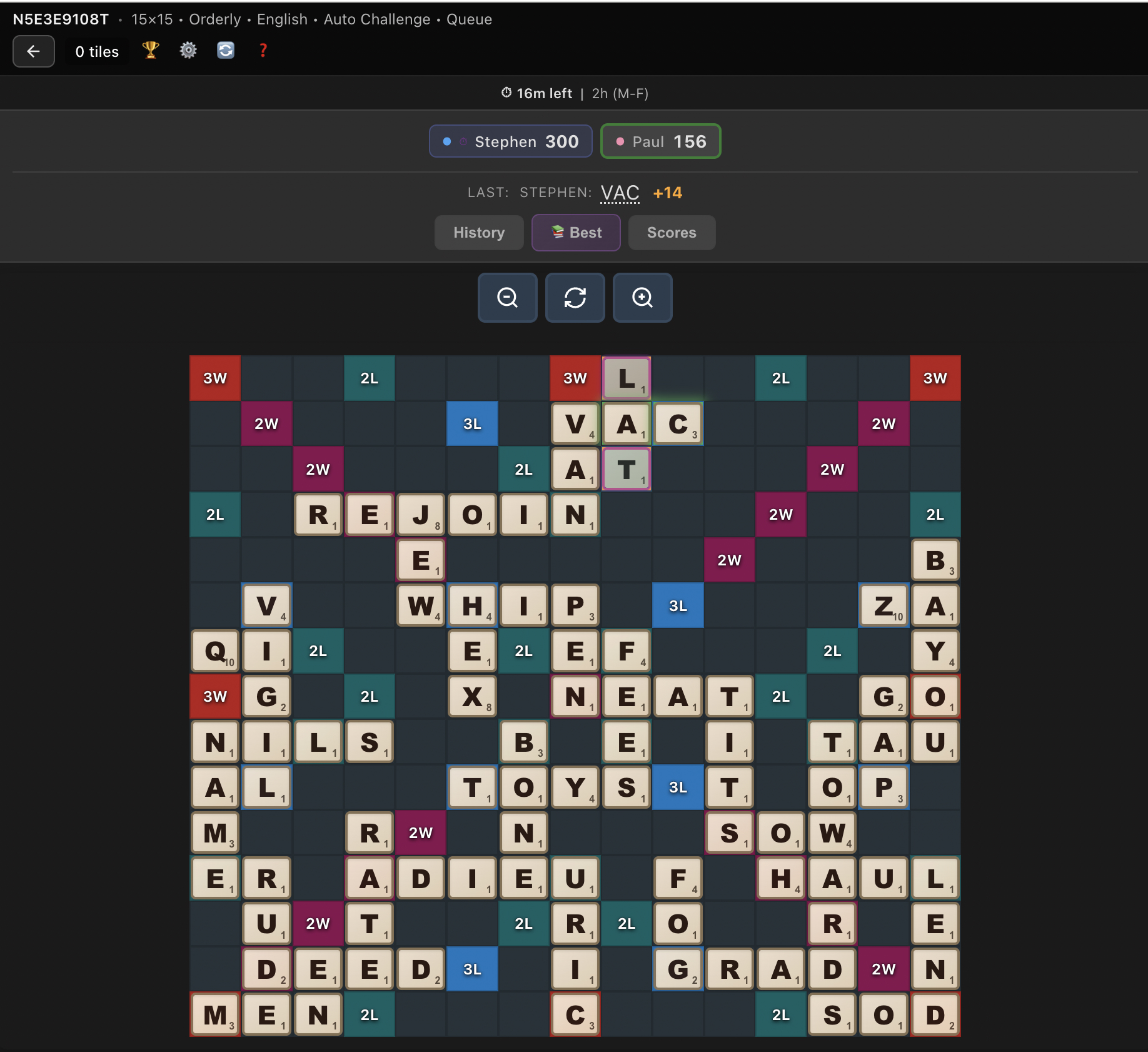
Quick Start: Place tiles on the board to form words. Each letter has a point value, and special board squares multiply letter or word scores. The player with the highest score when all tiles are played wins.
Board Sizes
Choose between two board configurations based on your preference and number of players:
| Board Type | Dimensions | Best For | Max Players |
|---|---|---|---|
| Standard | 15 × 15 | Traditional games, 2-4 players | 40 (with spectators) |
| Mega | 21 × 21 | Larger groups, longer games | 10 active players |
The Mega board provides 96% more playable squares, allowing for more complex word arrangements and accommodating larger player counts without running out of space.
Tile Values and Distribution
Each tile has a point value based on its frequency in the English language. Rarer letters are worth more points:
Point Values
| Points | Letters |
|---|---|
| 1 point | A, E, I, O, U, L, N, S, T, R |
| 2 points | D, G |
| 3 points | B, C, M, P |
| 4 points | F, H, V, W, Y |
| 5 points | K |
| 8 points | J, X |
| 10 points | Q, Z |
| 0 points | Blank tiles (wildcards) |
Blank Tiles
The two blank tiles can represent any letter. When placing a blank, you declare which letter it represents. Blanks are worth 0 points but provide crucial flexibility for completing difficult words.
Premium Squares
The board contains special squares that multiply your score:
- Double Letter Score (DL)
- The letter placed on this square scores double its face value.
- Triple Letter Score (TL)
- The letter placed on this square scores triple its face value.
- Double Word Score (DW)
- The entire word's score is doubled after calculating letter bonuses.
- Triple Word Score (TW)
- The entire word's score is tripled after calculating letter bonuses. The corner squares and certain other positions are TW squares.
Scoring Tip: Premium squares only apply on the turn a tile is placed on them. If you extend an existing word across a premium square already occupied by a tile, the bonus doesn't apply again.
Basic Gameplay
First Move
The first word must be placed so that one tile covers the center star square. This square is typically a Double Word Score square.
Subsequent Moves
After the first word, all new words must connect to existing tiles on the board. You can:
- Add to an existing word: Extend a word by adding letters before or after it
- Build perpendicular: Create a new word that intersects with an existing word
- Parallel play: Place a word parallel to an existing word, creating multiple new words at once
Valid Words
All words formed must be valid according to the selected dictionary. This includes:
- The main word you're placing
- Any secondary words created by parallel placement
- Any extensions to existing words
Drawing Tiles
After playing, draw tiles from the bag to replenish your rack to 7 tiles (or as many as remain in the bag).
Tile Exchange
If you're stuck with difficult tiles, you may exchange some or all of your tiles instead of playing a word. You forfeit your turn's score but receive new tiles from the bag. This is only available when at least 7 tiles remain in the bag.
Passing
You may pass your turn without playing or exchanging. If all players pass twice consecutively, the game ends.
Game Modes
Our implementation offers four distinct game modes, each providing a different experience:
Orderly Mode (Traditional)
The classic turn-based Scrabble experience:
- Players take turns in sequence
- Each player has time to consider their move
- Strategic planning and defensive play are key
- Best for: Competitive play, learning, tournaments
Real-Time Chaos Mode
A completely different experience where everyone plays simultaneously:
- No turn order - all players can place words at any time
- First valid placement wins the position
- Fast-paced, exciting, and unpredictable
- Board state changes constantly as players compete
- Best for: Casual fun, parties, players who dislike waiting
Chaos Mode Strategy: Speed matters! Identify high-scoring opportunities quickly and place your tiles before someone else takes that spot. Don't overthink - a decent word played fast beats a perfect word played too late.
Developer's Pick: The 2-minute Quick Scrabble is my personal favorite way to play. There's no time for overthinking, no time to sneak a peek at a word finder, no time for any tomfoolery - just fast, chaotic wordplay that completely changes the dynamic of the game.
Chaos Turn Mode
A hybrid approach combining aspects of both modes:
- All players move each round
- Moves are submitted independently
- Play validity is resolved when the round ends
- Best for: Larger groups wanting simultaneous play with structure
Two-By-Two Mode
Team-based Scrabble for four players:
- Players form two teams of two
- Teammates alternate turns
- Communication and coordination are key
- Combined team score determines winner
- Best for: Couples, family game nights, cooperative play
Challenge Modes
How word validity is handled can be configured with three different challenge modes:
Easy Mode (Pre-Validation)
The system validates words before they're played:
- Invalid words are rejected immediately
- You can try different words until you find a valid one
- No risk of losing a turn to an invalid word
- Best for: Learning, casual play, non-native speakers
Auto-Challenge Mode
Words are validated after being played:
- The system automatically checks each word
- Invalid words are removed, and the player loses their turn
- No player-to-player challenges needed
- Best for: Efficient games, online play
Manual Challenge Mode
Traditional challenge rules:
- Players can challenge words they believe are invalid
- If the challenge succeeds, the word is removed and the player loses their turn
- If the challenge fails, the challenger loses their next turn
- Creates mind games - bluff with obscure words!
- Best for: Competitive play, advanced players
Bluffing Strategy: In Manual Challenge mode, you can occasionally play obscure but valid words. Opponents may challenge and lose their turn if they're wrong!
Dictionary Support
Choose your preferred dictionary based on language and player preferences:
English Dictionary
The default dictionary with broad English word coverage including:
- Standard English vocabulary
- Common proper nouns (when allowed)
- Technical and specialized terms
German Dictionary
Full German language support for German-speaking players:
- Complete German vocabulary
- Umlauts and special characters handled
- Compound words supported
Mid-Game Dictionary Changes
Players can vote to change the dictionary during a game. This uses our democratic voting system - a majority vote is required to change.
Voting System
Our implementation includes a democratic voting system for changing game settings mid-game:
What Can Be Changed
- Game mode (switch between Orderly and Chaos modes)
- Dictionary (English to German or vice versa)
- Challenge mode (Easy, Auto, Manual)
- AI difficulty settings
How Voting Works
- Any player can propose a rule change
- All players receive a notification to vote
- A majority vote is required for changes to take effect
- The room creator can veto or force-approve changes if needed
This system allows groups to adapt the game to their preferences without restarting.
AI Opponents
Practice and improve your skills against computer players with three difficulty levels:
Easy AI
- Plays random valid words from its options
- Doesn't prioritize high-scoring moves
- Good for beginners learning the game
Medium AI
- Considers the top 3 scoring moves
- Some randomness in selection
- Provides moderate challenge for most players
Hard AI
- Always plays the highest-scoring move available
- Optimal word placement strategy
- Challenging even for experienced players
AI Word Finding: Our AI uses an exhaustive board analysis algorithm that evaluates every possible word placement, calculating both immediate points and strategic board position.
Scoring Guide
Basic Scoring
- Add up the point values of all letters in your word
- Apply any letter multipliers (DL, TL)
- Apply any word multipliers (DW, TW)
- If multiple words are formed, score each separately
Bingo Bonus
Using all 7 tiles in a single turn scores a 50-point bonus (commonly called a "bingo"). This rewards using difficult letters and planning ahead.
End Game Scoring
When the game ends (tiles exhausted or players pass consecutively):
- Each player loses points equal to the sum of their unplayed tiles
- If one player used all their tiles, they receive the sum of all opponents' unplayed tiles as bonus points
Strategy Tips
High-Scoring Plays
- Target premium squares: Plan moves that land high-value letters on TL squares or create words crossing TW squares
- Parallel plays: Create multiple words at once by playing parallel to existing words
- Use hooks: Add a single letter to an existing word to form a new word (e.g., adding S to make a plural)
Rack Management
- Balance vowels and consonants: Aim for roughly 2-3 vowels in your rack
- Keep flexible letters: S, blank tiles, and common letters like E and R provide options
- Don't hoard: If you have high-value letters like Q, J, or Z, try to use them rather than holding them
Defensive Play
- Block triple word squares: Don't set up easy TW access for opponents
- Avoid opening the board: In close games, keep the board tight to limit opponent options
- Track tiles: Know what letters are left to anticipate opponent plays
Two-Letter Words
Memorize two-letter words - they're essential for parallel plays and tight board positions. Common ones include: AA, AB, AD, AE, AG, AH, AI, AL, AM, AN, AR, AS, AT, AW, AX, AY, BA, BE, BI, BO, BY, and many more.
Platform Features
Ready to play? Play Scrabble now at games.stephenharlow.com. Challenge friends or test your skills against the AI!